|
Aspects
Now that we've learned how
to use astrology to talk about the basic energies
of our lives (the planets), how they express
themselves (the signs), and what areas of life they
are active in (the houses), we need to talk about
how those energies interact with each other.
In astrology, the quality of the relationship
between two planets depends on the geometry of
their placement in the sky. There are five such
patterns that are considered particularly important
(as well as other more subtle ones that we won't
get into here).
|
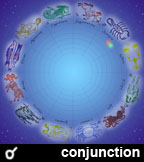 A
conjunction between planets occurs
when they are together in the sky. Two
planets are virtually never in exactly
the same spot, so "nearly the same
location" still counts. (Astrologers
disagree on how near is near enough, but
that's a minor detail. The other aspects
are considered approximate in this same
way.) When two planets are together like
this, they tend to merge their energies
into a single force, and act together. In
a Mercury-Sun conjunction, for example,
your sense of personal identity and
mission is fused with your capacity to
communicate and analyze. Your self-image
may be very verbal in character, and your
communications may be consistently direct
and self-aware. A
conjunction between planets occurs
when they are together in the sky. Two
planets are virtually never in exactly
the same spot, so "nearly the same
location" still counts. (Astrologers
disagree on how near is near enough, but
that's a minor detail. The other aspects
are considered approximate in this same
way.) When two planets are together like
this, they tend to merge their energies
into a single force, and act together. In
a Mercury-Sun conjunction, for example,
your sense of personal identity and
mission is fused with your capacity to
communicate and analyze. Your self-image
may be very verbal in character, and your
communications may be consistently direct
and self-aware.
|
|
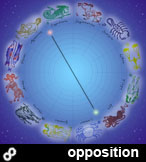 An
opposition is when two planets are
on opposite sides of the zodiac, 180
degrees apart. Most people experience an
opposition as a feeling of always having
to choose between those two planets. For
example, an opposition between Mars in
Sagittarius in the 1st house and Jupiter
in Gemini in the 7th house may be
experienced as a tension between the need
to go out into the world and succeed and
the need to enjoy pleasant, stimulating
relationships with others. An
opposition is when two planets are
on opposite sides of the zodiac, 180
degrees apart. Most people experience an
opposition as a feeling of always having
to choose between those two planets. For
example, an opposition between Mars in
Sagittarius in the 1st house and Jupiter
in Gemini in the 7th house may be
experienced as a tension between the need
to go out into the world and succeed and
the need to enjoy pleasant, stimulating
relationships with others.
|
|
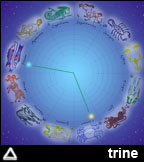 A
trine occurs when two planets are
120 degrees apart. (This is like one side
of a perfect triangle.) Planets in this
configuration naturally help each other;
they are like partners or best friends.
For example, if I have the Moon in
Taurus in my 4th house, and Saturn in
Virgo in my 8th house, the emotional
comfort I get from having a pleasant home
can provide a stable platform that allows
me to complete important personal tasks
and make important transitions. The
cooperation between the planets is often
mutual: the changes Saturn manages
and orchestrates can lead to a more
comfortable home for the Moon. A
trine occurs when two planets are
120 degrees apart. (This is like one side
of a perfect triangle.) Planets in this
configuration naturally help each other;
they are like partners or best friends.
For example, if I have the Moon in
Taurus in my 4th house, and Saturn in
Virgo in my 8th house, the emotional
comfort I get from having a pleasant home
can provide a stable platform that allows
me to complete important personal tasks
and make important transitions. The
cooperation between the planets is often
mutual: the changes Saturn manages
and orchestrates can lead to a more
comfortable home for the Moon.
|
|
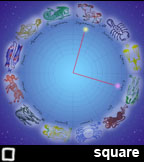 A square
is when two planets are 90 degrees
apart. (This is like one side of a square,
hence the name!) Planets in square aspect
do not understand or appreciate each
other, and tend to work at cross-purposes.
This is often considered the most
difficult aspect between planets. (At
least with an opposition, there is a clear
choice.) For example, Venus in Leo in
the 5th house loves recreational
activities that make her the center of
attention. Mars in Scorpio in the 8th
wants brood over injuries and conflicts.
They both make each other very
uncomfortable, but there is no obvious way
to resolve their different
approaches. A square
is when two planets are 90 degrees
apart. (This is like one side of a square,
hence the name!) Planets in square aspect
do not understand or appreciate each
other, and tend to work at cross-purposes.
This is often considered the most
difficult aspect between planets. (At
least with an opposition, there is a clear
choice.) For example, Venus in Leo in
the 5th house loves recreational
activities that make her the center of
attention. Mars in Scorpio in the 8th
wants brood over injuries and conflicts.
They both make each other very
uncomfortable, but there is no obvious way
to resolve their different
approaches.
|
|
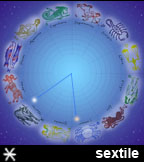 A
sextile is an angle of 60 degrees
between two planets, half the distance of
a trine. Planets in sextile are congenial
towards each other, but are not constant
collaborators like planets in trine are.
We may sometimes need to make a conscious
choice to have them together, but when we
do, it can be quite beneficial. A
sextile is an angle of 60 degrees
between two planets, half the distance of
a trine. Planets in sextile are congenial
towards each other, but are not constant
collaborators like planets in trine are.
We may sometimes need to make a conscious
choice to have them together, but when we
do, it can be quite beneficial.
|
Not every planet forms an aspect with every other
planet in your chart, of course. More often than
not, two planets will function separately, minding
their own business, and neither help nor hinder
each other.
Oppositions and squares,
although considered difficult aspects, nonetheless
carry a lot of energy. In the process of learning
to resolve the tensions they represent, we can
learn a lot about ourselves. They may also propel
us to create or discover something of lasting
value.
Final Exam
As a way to reinforce what
you have learned, you should get a copy of your own
birth chart and see if you can interpret it
yourself. Here's a little crib sheet about how to
proceed:
1. Identify your Sun sign,
your Moon sign, and your Rising sign (or
ascendant). These are the three most important
factors in most people's chart. I think of the Sun
sign as your mission, the Moon sign as your
womb, and the Rising sign as your
mask.
2. Find the sign for each of
the other planets (Mercury, Venus, Mars, Jupiter,
and Saturn at least - include Uranus, Neptune, and
Pluto if you like), and reflect on what those signs
say about how you express and experience each of
those planetary energies. You may want to check a
book or website that describes how planets behave
in each sign, but try to do it on your own
first.
3. Find the house for each
planet (Sun and Moon included), and see if you can
recognize those planets as active in that area of
your life.
4. Finally, single out any
strong aspects in your birth chart, and reflect on
the gifts or challenges they offer in terms of
using your planetary energies
effectively.
|